"Human history becomes more and more a race between education and catastrophe." - H.G. Wells, The Outline of History "We have tried to analyze the most baffling phenomena while disregarding structural peculiarities of languages..." -Alfred Korzybski, Science and Sanity Do UFOs exist? Most people who read about UFOs want that question answered. Knowing this, writers on the subject of UFOs often spend an entire book, or series of books, trying to prove whatever answer they provide. So that those demanding an assertive answer from this author won't feel cheated, I shall give one here as precisely and concisely as I can. Fortunately for the attention-deficient reader, this should require only a few paragraphs. First, to answer the question: Yes, UFOs exist. I say this with such certainty because I have seen them hundreds of times while driving to the store, taking a stroll, and just gazing up at the stars. In fact, I dare say that anyone who denies ever seeing a UFO has: a. lied, b. lost their vision, c. spent their life under a rock, d. misunderstood the definition of the term UFO. In the early 1950s, Captain Edward Ruppelt, head of the U.S. Air Force Project Blue Book investigation, coined the term UFO (Unidentified Flying Object) and its necessary counterpart IFO (Identified Flying Object). [see Clark, Jerome. The UFO Book: Encyclopedia of the Extraterrestrial (New York: Visible Ink Press, 1998).] We can consider the primary aspiration of ufology - a neologism denoting UFO investigation - as an attempt to accurately reclassify UFOs to IFOs. When you drive down the road at 50 mph and peripherally see a black blur, you have had a UFO experience by definition. If you take the time to look back and examine the perceived object/event in question, you have graduated into a ufologists of sorts. In your investigation, you may recognize the black blur as a member of the bird species C. brachyrhynchos. Having thus identified a crow, you have turned a UFO into an IFO. People see UFOs (and UNFOs, unidentified non-flying objects) quite frequently, and accurately turn them into IFOs (or INFOs) perhaps most of the time. At this point, I would wager that the reader has picked up on a problem with the term UFO. Put simply, the problem stems from the synonymity between UFOs and other-worldly spacecraft. This semantically-erroneous generalization of the term has caused much unwarranted controversy and confusion over the years. (We'll get back to this in a moment.) Another, perhaps more critical, problem exists in ufology which derives from the widespread use of the term Unidentified Flying Object in the first place. I refer to the fact that flying object implies qualities which do not accurately describe the characteristics of many documented sightings. According to definitions provided by my Merriam-Webster and American Heritage dictionaries, "flying object" signifies a material entity which propels itself through the air via some mechanical means. It seems ludicrous to cram all the data on unidentified things in the air into such a limited, elementalistic definition. To avoid ascribing inaccurate qualities across the board, I introduce the term UAP (an acronym, pronounced "you-app"), which stands for Unidentified Aerial Phenomenon. Like UFO, it also generates a counterpart, IAP (pronounced "eye-app," denoting Identified Aerial Phenomenon). I think these terms generalize the bulk of reported sightings far better than the terms UFO and IFO. I say this, first, because the word aerial does not necessarily denote self-propulsion, mechanisms, or an operator. More importantly, the word phenomenon in both physics and philosophy signifies an occurrence perceptible by the senses. This usage does not make hasty ontological judgments of physicality from the get-go. For instance, Kantian philosophy defines the word phenomenon as the appearance of something to the mind as opposed to its objective existence, independent of the mind. (I also think the word phenomenon incorporates a more modern scientific approach by its implication of perspectivism, as opposed to the archaic notion of "true objectivity" in the pre-quantum sense of "solid objects existing independent of an observer.") To illustrate the usefulness of UAP over UFO, I would direct the curious to the case of the enigmatic lights reported in the sky over Greifswald, (then) East Germany in 1990. [see UFOs: The Best Evidence Ever Caught on Video (J. Frakes, host. Broadcast in U.S. on Fox television network, July 1997).] According to some sources, dozens, if not hundreds, of German and Russian employees at a nuclear power plant witnessed the formation of unexplained luminous orbs which hovered above the restricted site for over an hour. At least one person produced a video tape of the dancing lights, and in a segment of the tape we see one of the orbs merge with another in midair. When we see "illusory" behavior like this, we feel compelled to ask whether the phenomenon had any physical mass to it at all. For the sake of argument, let's assume that the phenomenon actually occurred and that the Greifswald footage does not represent a computer generated hoax. If so, we might seek an explanation such as a demonstration of high-tech holography. If this theory proved accurate, then the terms UFO/IFO no longer seem applicable. As most people know, holographic projections do not constitute solid objects or involve mechanics of flight such as the aerodynamic lift generated from the camber of a wing. However, the term UAP (unidentified aerial phenomenon) works quite well to incorporate such "ethereal" possibilities. Similarly, Identified Aerial Phenomenon (IAP) describes holography in general as accurately as it incorporates such documented phenomenological possibilities as ball lightning (kugelblitz), corona discharges, vaporized barium clouds, hallucination, etc. (Note that the term Identified Flying Object falls short of the mark in these cases.) Four hundred years before the Greifswald video, in Nuremberg, scores of inhabitants reported seeing formations of illuminated spheres, cylinders, and disks above the town. [see Nuremberg Broadsheet, 1561. Reproduced in Carl Jung's Flying Saucers: A Modern Myth of Things Seen in the Skies (Princeton University Press, 2nd printing, 1991).] Using even the most extreme models available to ufologists - including various fringe psychological, theological, or extraterrestrial/extradimensional theories - to explain these events, UAP apples far better than UFO does. Aside from its more encompassing description, the term UAP avoids the heavy cultural baggage attached to UFO, who's initial association with "paranormal" origins, however true or untrue it may prove upon final analysis, sets up a narrow and inflexible framework for honest scientific research. An investigator can benefit greatly from using the term UAP, I think, simply because it does not have the cultural connotations of UFO. We can see this acculturation (or occulturation ) of the term UFO clearly in Polish Archbishop Jozef Miroslaw Zycinskis' reply at a Vatican news conference to a reporter's question concerning interest in UFOs. The Archbishop dismissed ufology as indicative of the 'intellectual paucity of our era'. [see Simpson, Victor L. "Pope defends Church Central Truths." Associated Press, 15 October 1998.] Many in mainstream science and academia seem to agree with the Archbishop's assertion. Physicist Bruce Maccabee, for example, notes the reality of ridicule that exists for those in the scientific community who investigate airborne anomalies, likening the endeavor to 'professional suicide.' [see Dr. Maccabee's online reply to New York Post editors' criticism of the recent ufological study conducted by the Society for Scientific Exploration (SSE). Paul Flatin of the Kyodo News Service (29 June 1998) wrote: "Despite the abundance of UFO reports over the past 50 years, the scientific community had shown little interest in the subject due to a lack of funding to support research and a perception that the field is not respectable, the [SSE] report said."] For a long time scientists sneered at reports by numerous witnesses of luminous phenomenon seen during earthquakes in various countries. Experts ascribed all kinds of explanations to the sightings, from hoax to hallucination. It took a team of scientists at Idu, Japan to accidentally observe the strange lights firsthand before they became an accepted occurrence.Until then, in spite of the abundance of eyewitness accounts, there was some doubt as to the reality of those long flashes of lightning, balls of fire, spreading beams, pencils of light, and curtains of varying color and intensity... Ordinary explanations for phenomena[a] of this kind - storm lightning, aurora borealis, electric arcs between high-tension cables, and above all, the witness' own emotion... could be refuted one after the other at Idu, and the luminous manifestations attributed to the earthquake. [from Tazieff, Haroun. When the Earth Trembles. (New York: Harcourt, Brace & World, Inc., 1966).] Science seems replete with mysterious aerial phenomena, including the earthlights at Idu, the more recent observations of lightning sprites, and numerous other unknowns of today. Bearing this in mind, I think the mental myopia of Scientific Orthodoxy concerning "UFOs" stands as a far better example of intellectual paucity than the investigation of as-yet unidentified phenomenon. If only we can internalize the concept of UAP over UFO... My research thus far indicates the use of the term "unidentified aerial phenomenon" as early as 22 March 1949, as described in a memo from the U.S. Strategic Air Command to the director of the FBI (released under the Freedom of Information Act, 1977). The reader should note that although I have advocated the initial use of the term UAP over UFO, I have not prescribed replacing it altogether. I say this for two reasons: 1. UFO has decades of cultural staying-power (as a MUFON State Director once quipped to me, "we're not going to change our name to MUAPN!"), and 2. despite its inherent neuro-semantic inadequacies, UFO has its place in the specialized study of ontological oddities. For instance, in his classic Anatomy of a Phenomenon (Chicago: Henry Regnery Co., 1965), Dr. Jacques Vallee wrote, "UFO phenomena are to be found among reports of objects, lights, beings, or physical effects that are regarded by the witnesses as anomalies because of their appearance or behavior." [see Vallee's Confrontations: A Scientists Search for Alien Contact (New York: Ballantine Books, 1990, p208-19) for more on definitions and classification systems in ufology.] As Vallee, Clark, Randles, and other veterans of ufology have extensively documented, many "UFO" cases don't even involve aerial phenomenon at all! To encompass these types of "Fortean" cases, I introduce a change from the conventional UFO (an acronym, all caps) to ufo (pronounced "you-foe"). [see "Mytho-Ufology" in the Winter-Spring 2000 issue of Rhesus Monkey Magazine for an example of ufo usage.] The reason for this change stems from linguistic and semantic factors concerning the term. As Professor Steven Pinker of MIT recently pointed out [in Words and Rules (New York: Basic Books, 1999, p28)], UFO has evolved, through decades of use, into a bona fide word. So why not treat it as such? Of course, we do not pronounce VCRs as "vikers" or POWs as a sound effect in a comic book, so why change the pronunciation of UFOs ("you-eff-ohs")? Put simply, the term UFO no longer remains synonymous with its root, no longer operates as a "true" acronym. (This goes to explain the confusing resulting from polls which ask people questions like, "do you believe in UFOs", or "do you think the government knows more about UFOs then they divulge to the public.") Thus changing the defunct acronym to a base word divorces it from its old meaning to accord with modern multiordinal interpretations. Since this essay's original printing [in the Spring 1999 issue of ETC: A Review of General Semantics (Concord, CA: International Society for General Semantics, Vol56 No1, p53-9)] my prescribing the general use of the word ufo has only seen opponents, curiously enough, from some ufologists (and a few writers of the "paranormal"). Since a few of the bios printed about me claim otherwise, I feel I should state for the record that - although I have done much work interviewing, researching, writing, etc. in their field of study - I do not consider myself a "ufologist" (or any other kind of "ologist" for that matter). It does, however, seem wryly amusing to note that the few "ufologists" who disdainfully replied to my verbal alteration of UFO to ufo actually referred to themselves as ufologists ("you-follow-gists") in their calls and letters to me, not one having called themself a UFO-logist ("you-eff-oh-low-gist"). You follow the gist? Dr. Jacques Vallee has commented, with great disappointment, that ufology seems to have 'slipped back into its infancy.' [see report in the online November-December 1995 issue of UFO Magazine, "Jacques Vallee Issues Warning to UFO Researchers."] Perhaps the re-introduction of the "technical" term Unidentified Aerial Phenomenon and my prescription of the word ufo will help to ensure this field of investigation avoids unnecessary atavism and academic enmity. As Tennessee Williams once said, "It's an unanswered question, but let us still believe in the dignity and importance of the question." We can use all the help we can get in a field of scientific investigation whose subjects remain - to borrow a phrase - up in the air.
..read more...
Minggu, 02 November 2008
Kamis, 01 November 2007
THE BROWN MOUNTAIN LIGHTS
For centuries, mysterious lights have baffled observers on Brown Mountain in Burke County, North Carolina. The strange lights are often described as white, red, or yellow balls of light. They reportedly move around or remain stationary. Sometimes they are said to look like misty spheres or produce a sizzling sound. Close encounters with the lights have been said to cause dizziness as was described in a 1962 report in the "Charlotte Observer". Twelve eyewitnesses watched the lights from a 60-foot tower. When one of the lights approached one of the men, he suddenly had "a static-like feeling of dizziness". According to the report, when the men climbed down from the tower, they were unable to stand. Explanations for the lights range from several ghostly legends to scientific theories including ball lightning and "earth-lights".
Dating back to 800 year-old Cherokee legends where the lights were said to be the spirits of slain warriors, the Brown Mountain Lights have been observed and investigated numerous times. In 1771, German engineer Geraud de Brahm wrote about the lights in his journals. In an attempt to provide a scientific explanation for the phenomenon, de Brahm wrote: "The mountains emit nitrous vapors which are borne by the wind and when laden winds meet each other the niter inflames, sulphurates and deteriorates." "The Charlotte Observer", a local newspaper, was the first to feature a story on the lights in 1913. W. J. Humphries, of the U.S. Weather Bureau investigated the lights and compared them to a similar phenomenon in the Andes Mountains of South America.
Another government organization, the U.S. Geological Survey, launched two expeditions on Brown Mountain in 1916 and 1922, digging deeper into the mystery. During the 1922 survey, scientist George Rogers Mansfield found a variety of possible causes for the lights including cars, trains, stationary lights and brush fires. Fireflies were even a culprit, but were later viewed as an unlikely explanation. While Mansfield found numerous possibilities for the cause of the lights, he found that a small percentage still had no known cause. Others who have investigated the phenomenon suggest they are "earth lights", a luminous phenomenon caused my seismic activity. Mirages, ball lightning, and swamp gas (despite the lack of swamps on Brown Mountain) have all failed to completely explain the nature of the lights.
The luminous orbs eventually made their way into a bluegrass hit, "The Legend of the Brown Mountain Light," performed by musician Tommy Faile in the 1960’s.
Over a two-week period in November 2000, L.E.M.U.R. Paranormal Research Team based in Asheville, North Carolina observed and filmed the Brown Mountain Lights using an Infrared Night Vision camera. Over an hour of activity was captured on the first known video evidence of the Brown Mountain Lights. L.E.M.U.R. hopes this footage will yield more clues about the mysterious lights that always have eluded a suitable explanation.
The L.E.M.U.R. team plans to show the footage during the First Annual Paranormal Weekend in Asheville, N.C. on January 11-13, 2002. Joshua P. Warren, founder and president of L.E.M.U.R., has written two books, "Haunted Asheville" and "How To Hunt Ghosts". "I believe footage of this quality is the most significant step forward in the history of researching the lights," says Warren. "By studying the video, we’re targeting places on the ridge to research further. Ultimately, we hope to solve the mystery."
..read more...
Dating back to 800 year-old Cherokee legends where the lights were said to be the spirits of slain warriors, the Brown Mountain Lights have been observed and investigated numerous times. In 1771, German engineer Geraud de Brahm wrote about the lights in his journals. In an attempt to provide a scientific explanation for the phenomenon, de Brahm wrote: "The mountains emit nitrous vapors which are borne by the wind and when laden winds meet each other the niter inflames, sulphurates and deteriorates." "The Charlotte Observer", a local newspaper, was the first to feature a story on the lights in 1913. W. J. Humphries, of the U.S. Weather Bureau investigated the lights and compared them to a similar phenomenon in the Andes Mountains of South America.
Another government organization, the U.S. Geological Survey, launched two expeditions on Brown Mountain in 1916 and 1922, digging deeper into the mystery. During the 1922 survey, scientist George Rogers Mansfield found a variety of possible causes for the lights including cars, trains, stationary lights and brush fires. Fireflies were even a culprit, but were later viewed as an unlikely explanation. While Mansfield found numerous possibilities for the cause of the lights, he found that a small percentage still had no known cause. Others who have investigated the phenomenon suggest they are "earth lights", a luminous phenomenon caused my seismic activity. Mirages, ball lightning, and swamp gas (despite the lack of swamps on Brown Mountain) have all failed to completely explain the nature of the lights.
The luminous orbs eventually made their way into a bluegrass hit, "The Legend of the Brown Mountain Light," performed by musician Tommy Faile in the 1960’s.
Over a two-week period in November 2000, L.E.M.U.R. Paranormal Research Team based in Asheville, North Carolina observed and filmed the Brown Mountain Lights using an Infrared Night Vision camera. Over an hour of activity was captured on the first known video evidence of the Brown Mountain Lights. L.E.M.U.R. hopes this footage will yield more clues about the mysterious lights that always have eluded a suitable explanation.
The L.E.M.U.R. team plans to show the footage during the First Annual Paranormal Weekend in Asheville, N.C. on January 11-13, 2002. Joshua P. Warren, founder and president of L.E.M.U.R., has written two books, "Haunted Asheville" and "How To Hunt Ghosts". "I believe footage of this quality is the most significant step forward in the history of researching the lights," says Warren. "By studying the video, we’re targeting places on the ridge to research further. Ultimately, we hope to solve the mystery."
THE POPOBAWA - A ZANZIBARI INCUBUS

The infamous Popobawa has struck again causing panic in the Zanzibar islands off the coast of Tanzania in Africa. The "creature", described as a cyclops dwarf with bat-like wings and ears, and sharp talons, is feared for its nasty habit of sodomizing men while they sleep in their beds. The presence of the often invisible Popobawa can be detected by an acrid smell or a puff of smoke. Sometimes, the Popobawa is visible to everyone except the terrified victim. It is believed to take human form by day, but with pointed fingers. After doing its vile deed, the Popobawa instructs its victims to spread the word about their ordeal or it would be back.
The Popobawa, its name derived from the Swahili words for "bat" and "wing", first appeared in the neighboring island of Pemba in 1972. More attacks were reported in the 1980s, again in April of 1995, and recently in 2000 and July 2001. Attacks appear to coincide with political stress such as election. The 1972 attacks followed the assassination of the country’s president. Interestingly, the recent attacks have come without any political turmoil.
Hospitals in Zanzibar have treated numerous broken ribs, bruises, and other injuries attributed to the Popobawa. One mentally ill man was hacked to death after confessing that he was the troublesome demon. During times when the Popobawa terrorizes the islands, whole families will often sleep arm-in-arm in front of their houses, seeking safety in numbers.
Mjaka Hamad, a peasant farmer in his mid-50s and a victim of the Popobawa’s attacks in 1995, has related his ordeal to the media. "I could feel it," Hamad said. "...something pressing on me. I couldn’t imagine what sort of thing was happening to me. You feel as if you are screaming with no voice. It was just like a dream but then I was thinking it was this Popobawa and he had come to do something terrible to me, something sexual. It is worse than what he does to women." Hamad claimed that he did not believe in the Popobawa or other spirits before the attack and suggests that is the reason he was attacked. "I don’t believe in spirits so maybe that’s why it attacked me. Maybe it will attack anybody who doesn’t believe."
The Popobawa appears to be an African version of the wide-spread Mara phenomenon. Joe Nickell, an investigator with CSICOP (Committee for the Scientific Investigation of Claims of the Paranormal), has compared the Popobawa to Medieval legends of succubi (female spirits) and incubi (male spirits) who sexually molested their victims in bed at night. In Newfoundland, an ugly old woman sexually molested men in a phenomenon known as Hagging. Other similar reports from around the world describe vampires, formless black blobs, and extraterrestrials among other bizarre entities.
Skeptics claim that these experiences are a result of a hypnogogic hallucination during a "waking dream". Paralysis, a sense of being weighted down, floating sensations, and encounters with otherworldly beings are often all unifying characteristics of the phenomenon.
The Popobawa, its name derived from the Swahili words for "bat" and "wing", first appeared in the neighboring island of Pemba in 1972. More attacks were reported in the 1980s, again in April of 1995, and recently in 2000 and July 2001. Attacks appear to coincide with political stress such as election. The 1972 attacks followed the assassination of the country’s president. Interestingly, the recent attacks have come without any political turmoil.
Hospitals in Zanzibar have treated numerous broken ribs, bruises, and other injuries attributed to the Popobawa. One mentally ill man was hacked to death after confessing that he was the troublesome demon. During times when the Popobawa terrorizes the islands, whole families will often sleep arm-in-arm in front of their houses, seeking safety in numbers.
Mjaka Hamad, a peasant farmer in his mid-50s and a victim of the Popobawa’s attacks in 1995, has related his ordeal to the media. "I could feel it," Hamad said. "...something pressing on me. I couldn’t imagine what sort of thing was happening to me. You feel as if you are screaming with no voice. It was just like a dream but then I was thinking it was this Popobawa and he had come to do something terrible to me, something sexual. It is worse than what he does to women." Hamad claimed that he did not believe in the Popobawa or other spirits before the attack and suggests that is the reason he was attacked. "I don’t believe in spirits so maybe that’s why it attacked me. Maybe it will attack anybody who doesn’t believe."
The Popobawa appears to be an African version of the wide-spread Mara phenomenon. Joe Nickell, an investigator with CSICOP (Committee for the Scientific Investigation of Claims of the Paranormal), has compared the Popobawa to Medieval legends of succubi (female spirits) and incubi (male spirits) who sexually molested their victims in bed at night. In Newfoundland, an ugly old woman sexually molested men in a phenomenon known as Hagging. Other similar reports from around the world describe vampires, formless black blobs, and extraterrestrials among other bizarre entities.
Skeptics claim that these experiences are a result of a hypnogogic hallucination during a "waking dream". Paralysis, a sense of being weighted down, floating sensations, and encounters with otherworldly beings are often all unifying characteristics of the phenomenon.
news source of www.xprojectmagazine.com
..read more...
BERMUDA TRIANGLE

On 5 December 1945, disaster was about to strike the personnel of Fort Lauderdale in Florida. That afternoon five torpedo-bombers took off on a routine training flight. Soon, things began to go wrong. The flight leader reported equipment malfunctions, gyro-compasses went crazy, and he lost his horizon. Finally, he reported that he was lost. This happened just off the Florida coast and, as the day progressed, the weather worsened rapidly. Two hours later, the aircraft disappeared and were never seen again. No bodies were found and no wreckage spotted.In isolation, the tragedy was not unprecedented. Disorientation is easy to achieve over water and, if lost, it is easy to fly until your fuel runs out, simply falling from the sky. The lack of evidence of a crash was unusual but, again, it has happened before. But what do we make of a sixth plane - part of the search and rescue operation - blowing up less than half an hour after take-off, with total loss of life?
A CATALOGUE OF DISASTER
The above is one of the major episodes of what has become known as the Bermuda Triangle. Others include the loss of two aircraft in 1948, taking sixty lives. In 1950 a freighter disappeared with all hands. 1963 saw a triple tragedy with the loss of another freighter and three large aircraft.Indeed, if you add up the minor incidents as well you come up with a continuous list of mysterious disappearances of over 140 ships and planes and a thousand lives. The greatest tragedy happened in March 1918. Sailing from Barbados to Norfolk, Virginia, the US Navy Supply Vessel Cyclops disappeared without trace, taking three hundred lives.The Bermuda Triangle stretches from Bermuda to Cuba, and along the US coast from Miami to New York. Sceptics would argue there is no mystery as traffic is so dense that disasters are inevitable. But a whole industry of the fantastic has been built up to explain such disappearances.
PSEUDOSCHOLASTIC SHENNANIGANS
Vincent Gaddis blamed a space-time continuum touching our dimension at this point.Charles Berlitz put it down to UFO activity and time warps. A Dr Kenneth McCall postulated the tormented souls of black slaves thrown overboard to be cursing the area.Ivan Sanderson suggested a slightly less bizarre theory with his magnetic vortices. Identifying similar areas around the Earth, such vortices are formed where warm and cold currents collide.A further idea is offered by geo-chemist, Dr Richard McIver, who blames gas hydrates trapped in the seabed. Geo-disturbances can cause the release of large amounts of methane. When this happens, the sea can go frothy, like the head of beer, causing ships to lose buoyancy and sink.When the methane reaches the air, a plane engine can cause it to ignite, the wreckage falling into the frothy sea and disappearing. However, whilst this last theory holds real possibilities, perhaps we are looking at the mystery from the wrong angle.
CLEARING THE FOG
From the myriad disasters and close escapes in the area a list of factors leading to disaster can be highlighted. For instance, escapees speak, almost unanimously, of faulty gyro-compasses, equipment malfunction, loss of horizon, lack of wreckage, planes blowing up, water seeming to rise up as if a water-spout, dense banks of sudden fog, and sudden turbulent waters.Yet each of the above events are experienced all the time by sailors and airmen the world over. There is nothing really unusual about any of them in isolation. What IS unusual is that, in the Bermuda Triangle, they all seem to strike at once. We have a word for such a congregation of events. Coincidence.Even skeptics are wary of using this word to explain the Bermuda Triangle. Better, they think, to not think about it at all. After all, the mystery is just so ridiculous. But this is a mistake. For instance, you do not need to study other disasters for long before you realize that coincidence is often the major factor in disaster. It is the coming together of small mistakes and failures that build up to the coincidental congregation of events that cause disaster.
AN INEVITABLE THEORY
This is, actually, inevitable. The universe is obviously designed in such a way as to allow coincidental happenings to occur. If it wasn’t, they simply wouldn’t happen. The law of chance itself demands that coincidences DO occur. Indeed, in such a ‘coincidental’ universe, the Bermuda Triangle is, itself, an inevitability, for coincidence would dictate that sometime, somewhere, a congregation of events must come to a particular location.Folklore would speak of such an inevitability with terms such as curse or jinx. This, in itself, is interesting. For inevitability can have a marked effect on the human mind, causing people to make silly mistakes they otherwise would not make. For instance, if you think you’re going to have an accident, you will be wary and perform different to the norm, increasing the possibilities of an accident happening. Hence, could it be that, as a culture of disaster arose in the area, human psychology dictated that the prevalence of mistakes would increase?Science is quite rightly based on Reductionism, where the simplest explanation is preferred, and the ‘incidences’ of single events take priority over the wider ‘pattern’ of related events. But I am sure that science requires a bedfellow in terms of a more holistic way of looking at things – a discipline I have called Patternology, or P-ology.The Bermuda Triangle could be a classic example for P-ological study, for nowhere else has such a congregation of events occurred, ripe for analysis and study. The suggested statistical bias towards disaster, combined with a possible collective human psychology of inevitability, could be studied in the raw, with the possible outcome of a ‘science of disaster’ that could offer guidance for avoiding disaster in the future.To ignore such a possibility is to condemn us to a continuing bias towards disaster.
A CATALOGUE OF DISASTER
The above is one of the major episodes of what has become known as the Bermuda Triangle. Others include the loss of two aircraft in 1948, taking sixty lives. In 1950 a freighter disappeared with all hands. 1963 saw a triple tragedy with the loss of another freighter and three large aircraft.Indeed, if you add up the minor incidents as well you come up with a continuous list of mysterious disappearances of over 140 ships and planes and a thousand lives. The greatest tragedy happened in March 1918. Sailing from Barbados to Norfolk, Virginia, the US Navy Supply Vessel Cyclops disappeared without trace, taking three hundred lives.The Bermuda Triangle stretches from Bermuda to Cuba, and along the US coast from Miami to New York. Sceptics would argue there is no mystery as traffic is so dense that disasters are inevitable. But a whole industry of the fantastic has been built up to explain such disappearances.
PSEUDOSCHOLASTIC SHENNANIGANS
Vincent Gaddis blamed a space-time continuum touching our dimension at this point.Charles Berlitz put it down to UFO activity and time warps. A Dr Kenneth McCall postulated the tormented souls of black slaves thrown overboard to be cursing the area.Ivan Sanderson suggested a slightly less bizarre theory with his magnetic vortices. Identifying similar areas around the Earth, such vortices are formed where warm and cold currents collide.A further idea is offered by geo-chemist, Dr Richard McIver, who blames gas hydrates trapped in the seabed. Geo-disturbances can cause the release of large amounts of methane. When this happens, the sea can go frothy, like the head of beer, causing ships to lose buoyancy and sink.When the methane reaches the air, a plane engine can cause it to ignite, the wreckage falling into the frothy sea and disappearing. However, whilst this last theory holds real possibilities, perhaps we are looking at the mystery from the wrong angle.
CLEARING THE FOG
From the myriad disasters and close escapes in the area a list of factors leading to disaster can be highlighted. For instance, escapees speak, almost unanimously, of faulty gyro-compasses, equipment malfunction, loss of horizon, lack of wreckage, planes blowing up, water seeming to rise up as if a water-spout, dense banks of sudden fog, and sudden turbulent waters.Yet each of the above events are experienced all the time by sailors and airmen the world over. There is nothing really unusual about any of them in isolation. What IS unusual is that, in the Bermuda Triangle, they all seem to strike at once. We have a word for such a congregation of events. Coincidence.Even skeptics are wary of using this word to explain the Bermuda Triangle. Better, they think, to not think about it at all. After all, the mystery is just so ridiculous. But this is a mistake. For instance, you do not need to study other disasters for long before you realize that coincidence is often the major factor in disaster. It is the coming together of small mistakes and failures that build up to the coincidental congregation of events that cause disaster.
AN INEVITABLE THEORY
This is, actually, inevitable. The universe is obviously designed in such a way as to allow coincidental happenings to occur. If it wasn’t, they simply wouldn’t happen. The law of chance itself demands that coincidences DO occur. Indeed, in such a ‘coincidental’ universe, the Bermuda Triangle is, itself, an inevitability, for coincidence would dictate that sometime, somewhere, a congregation of events must come to a particular location.Folklore would speak of such an inevitability with terms such as curse or jinx. This, in itself, is interesting. For inevitability can have a marked effect on the human mind, causing people to make silly mistakes they otherwise would not make. For instance, if you think you’re going to have an accident, you will be wary and perform different to the norm, increasing the possibilities of an accident happening. Hence, could it be that, as a culture of disaster arose in the area, human psychology dictated that the prevalence of mistakes would increase?Science is quite rightly based on Reductionism, where the simplest explanation is preferred, and the ‘incidences’ of single events take priority over the wider ‘pattern’ of related events. But I am sure that science requires a bedfellow in terms of a more holistic way of looking at things – a discipline I have called Patternology, or P-ology.The Bermuda Triangle could be a classic example for P-ological study, for nowhere else has such a congregation of events occurred, ripe for analysis and study. The suggested statistical bias towards disaster, combined with a possible collective human psychology of inevitability, could be studied in the raw, with the possible outcome of a ‘science of disaster’ that could offer guidance for avoiding disaster in the future.To ignore such a possibility is to condemn us to a continuing bias towards disaster.
The Tesla Connection
Oliver Nichelson has a very interesting web site entitled, "Tesla Wireless and the Tunguska Explosion" that advocates this theory, with some very compelling information about the background and secret experiments of the Serbian-born American inventor. "Tesla's writings have many references to the use of his wireless power transmission technology as a directed energy weapon," says Nichelson. "The Tunguska explosion of 1908 may have been a test firing of Tesla's energy weapon."
Nichelson details many of the experiments with electricity conducted by Tesla in many areas of the United States. He relates one such experiment at his Colorado Springs laboratory where he erected a 200-foot pole topped by a large copper sphere that discharged lighting bolts up to 135 feet long.
"People along the streets were amazed to see sparks jumping between their feet and the ground," Nichelson writes. "Flames of electricity would spring from a tap when anyone turned them on for a drink of water. Light bulbs within 100 feet of the experimental tower glowed when they were turned off." Nichelson then chronicles the evolution of Tesla's method of the wireless transmission of electrical energy, and how it led up to the secret test in 1908. Apparently, Tesla had proved that directed electrical energy could be used as a beneficial or destructive force. "Beset by financial problems and spurned by the scientific establishment, Tesla was in a desperate situation by mid-decade... and, according to Tesla's biographers, he suffered an emotional collapse. In order to make a final effort to have his grand scheme recognized, he may have tried one high-power test of his transmitter to show off its destructive potential. This would have been in 1908."
Nichelson details many of the experiments with electricity conducted by Tesla in many areas of the United States. He relates one such experiment at his Colorado Springs laboratory where he erected a 200-foot pole topped by a large copper sphere that discharged lighting bolts up to 135 feet long.
"People along the streets were amazed to see sparks jumping between their feet and the ground," Nichelson writes. "Flames of electricity would spring from a tap when anyone turned them on for a drink of water. Light bulbs within 100 feet of the experimental tower glowed when they were turned off." Nichelson then chronicles the evolution of Tesla's method of the wireless transmission of electrical energy, and how it led up to the secret test in 1908. Apparently, Tesla had proved that directed electrical energy could be used as a beneficial or destructive force. "Beset by financial problems and spurned by the scientific establishment, Tesla was in a desperate situation by mid-decade... and, according to Tesla's biographers, he suffered an emotional collapse. In order to make a final effort to have his grand scheme recognized, he may have tried one high-power test of his transmitter to show off its destructive potential. This would have been in 1908."
In fact, perhaps Tesla was confessing in 1915 when he wrote: "It is perfectly practical to transmit electrical energy without wires and produce destructive effects at a distance. I have already constructed a wireless transmitter which makes this possible. But when unavoidable [it] may be used to destroy property and life. The art is already so far developed that the great destructive effects can be produced at any point on the globe, defined beforehand with great accuracy."
The Tesla experiment might also account for the enigmatic aspects of the Tunguska event, according to Nichelson: the lack of a crater; the disturbances in the planet's magnetic field; the odd glow in the sky seen before and after the event; the radiation-like burns; and the electromagnetic pulse.
The test, however, may not have been a complete success, says Nichelson. Tesla may have been aiming for the completely uninhabited region of the north pole. He may have overshot his target.
Research Continues
Scientists continue to research the Tunguska event and debate its causes. As recently as 1996, they gathered in Bologna, Italy for the Tunguska International Workshop. More than 65 participants attended the conference, mostly Russians and Americans, but no consensus was reached. The scientists remained divided between those who favor the meteorite hypothesis and those who favor the comet hypothesis.
Why is it important to study Tunguska? Because it may have been the most recent occurrence of a major meteor or comet impact on our planet. If it had struck over a major city instead of an isolated forest, hundreds of thousands of people would have been killed.
But no one at the conference, it seemed, was seriously interested in the Tesla theory, nor in the suggestion raised that the explosion was actually caused by an errant, 2,000-year-old Japanese nuclear spacecraft returning home... but missing the runway.
So What Happened?
The theories put forth to account for the Tunguska event range from the scientifically plausible to the ridiculous to the intriguing. They included:
A fragmentary asteroid or meteorite that exploded in the atmosphere.
The nucleus of a comet that likewise exploded in the atmosphere.
An unusual tectonic event.
A tiny black hole that entered the Earth's atmosphere from outer space and imploded. A chunk of antimatter that reacted with the matter of our planet.
A crashed UFO, the propulsion drive of which exploded.
A deliberate attack by extraterrestrials.
The result of a test of Nikola Tesla's wireless power transmitter.
Again, there's no definitive proof for any of these ideas, but let's consider each.
Asteroid - This and the comet theory are favored by scientists, of course - mainly because they can't conceive of any other explanation.
I'd have to agree that it's the most likely. But because there is no crater and little debris, there's only circumstantial evidence. Before Tunguska, scientists rarely considered that an asteroid would explode in the atmosphere before striking the ground. Yet, because there is no crater, they reason, that must be what happened. So where are all the fragments of the asteroid that they estimate must have weighed some 100,000 tons? Vaporized, they say - pulverized into dust and tiny gravel. The only fragments found thus far have been tiny glass nodules embedded in the fallen trees, which are consistent in makeup with stony asteroid fragments that have been super-heated.
Comet - This is the prevailing theory today - that it was a 100,000-ton fragment of Encke's Comet. Since there is little debris, the explosion might be consistent with a comet, which generally is a loose mixture of stone and ice. Upon explosion, very little debris would remain as evidence. Ironically, it is the very lack of evidence that boosts the credibility of the comet theory.
An unusual tectonic event - Andrei Yu. Ol'khovatov, a Russian scientist, has recently come up with the interesting, plausible theory that Tunguska was "a geophysical event, associated with tectonic processes" - a powerful earthquake, the enormous pressures of which also resulted in the recorded atmospheric effects.
Black hole - This idea isn't taken very seriously by mainstream scientists, simply because it's not known whether such small black holes even exist. And if they did, what the result would be upon one entering our atmosphere is completely unknown.
Antimatter - This idea is also readily dismissed, since it is unlikely that antimatter would be able to transverse space and reach our planet without already encountering some matter and annihilating.
Crashed UFO - There's no evidence whatever of this idea, of course. No fragments of the spacecraft or piece of an alien's intergalactic map. If it were the explosion of the UFO's propulsion system - nuclear or whatever - it might have vaporized all traces of the ship, but come on....
Extraterrestrial attack - If they were going to attack, why would they choose an unpopulated region, unless their intelligence was bad? Or unless it was meant as just a warning. And it it was just a warning, where was the follow-up or contact?
Nikola Tesla's experiment - Granted, this idea is far more unlikely than an asteroid or comet strike, but I find it quite a bit more interesting. A lot of myth has grown around the mysterious, dark and temperamental figure of Tesla. Although known as the discoverer of the principals of alternating current and other inventions, he is also credited in some quarters with far more notorious inventions, including a death ray. Some say the controversial HAARP array in Alaska is a continuation of Tesla's experiments that used electricity to create super weapons. The Tunguska event, they say, was the result of a test of such a weapon - a test that didn't go exactly as planned.
..read more...
The Tunguska Mystery
 In 1908, something exploded in an isolated area of Siberia. What was it?"
I was sitting on the porch of the house at the trading station, looking north. Suddenly, in the north... the sky was split in two, and high above the forest the whole northern part of the sky appeared covered with fire. I felt a great heat, as if my shirt had caught fire. At that moment, there was a bang in the sky, and a mighty crash. I was thrown twenty feet from the porch. The earth trembled."
Dialogue from some asteroid impact movie? An excerpt from a science fiction novel? A witness to the test of a nuclear explosion? The witness is real, but the event was not the test of an atomic or nuclear device. And it certainly wasn't fiction.
This incredible event, related by this Russian witness, took place on the morning of June 30, 1908 in a remote area of Siberia called Tunguska. And exactly what happened there is still unknown. There are several theories as to what caused the great explosion in the sparsely populated forest at 62 degrees north latitude, but there is no definitive proof for any of them. Nearly 100 years later, the debate about the Tunguska event continues.
Whatever happened, the resulting devastation was enormous. A fireball as bright as the sun was seen streaking across the sky. Observers 300 miles away heard deafening bangs. Trees were flattened in a radial pattern over an area of 850 square miles. Seismic vibrations were recorded by instruments as far away as 600 miles. Fires burned for weeks. Forty miles from ground zero, people were thrown to the ground and knocked unconscious. One man was hurled into a tree and killed. Scientists examining the area calculated that the explosion was equivalent to 40 megatons of TNT - 2,000 times the force of the atomic bomb released on Hiroshima in 1945. Yet there was no crater.
Other, more enigmatic effects were recorded:
-disturbances in the Earth's magnetic field
Dialogue from some asteroid impact movie? An excerpt from a science fiction novel? A witness to the test of a nuclear explosion? The witness is real, but the event was not the test of an atomic or nuclear device. And it certainly wasn't fiction.
This incredible event, related by this Russian witness, took place on the morning of June 30, 1908 in a remote area of Siberia called Tunguska. And exactly what happened there is still unknown. There are several theories as to what caused the great explosion in the sparsely populated forest at 62 degrees north latitude, but there is no definitive proof for any of them. Nearly 100 years later, the debate about the Tunguska event continues.
Whatever happened, the resulting devastation was enormous. A fireball as bright as the sun was seen streaking across the sky. Observers 300 miles away heard deafening bangs. Trees were flattened in a radial pattern over an area of 850 square miles. Seismic vibrations were recorded by instruments as far away as 600 miles. Fires burned for weeks. Forty miles from ground zero, people were thrown to the ground and knocked unconscious. One man was hurled into a tree and killed. Scientists examining the area calculated that the explosion was equivalent to 40 megatons of TNT - 2,000 times the force of the atomic bomb released on Hiroshima in 1945. Yet there was no crater.
Other, more enigmatic effects were recorded:
-disturbances in the Earth's magnetic field

-a local geomagnetic storm
-a reversal of soil magnetization
-a reversal of soil magnetization
-an electromagnetic pulse, similar to what would becreated by a nuclear explosion
-aurora displays before and after the event
-unusually bright nights seen before and after the event
-genetic mutations in plants and animals
-accelerated growth of plants afterward
-radiation-like burns and deaths of exposed people.
Selasa, 02 Oktober 2007
The Legent of Sea Monster "Siren"

In Greek mythology the Sirens were sea deities who lived on an island called Sirenum scopuli. In some different traditions they are placed on Cape Pelorum, others in the island of Anthemusa, and still others in the Sirenusian islands near Paestum, or in Capreae (Strab. i. p. 22 ; Eustath. ad Horn. p. 1709 ; Serv. I.e.). All locations were described to be surrounded by cliffs and rocks. Seamen who sailed near were decoyed with the Sirens' enchanting music to shipwreck on the rocky coast.
The Sirens were considered the daughters of Achelous (by Terpsichore, Melpomene, Sterope, Chthon (in Euripides' Helen)) or Phorcys (Virgil. V. 846; Ovid XIV, 88). Homer says nothing of their number, but later writers mention both their names and number ; some state that they were two, Aglaopheme and Thelxiepeia (Eustath. ad Horn. p. 1709) ; and others, that there were three, Peisinoe, Aglaope, and Thelxiepeia (Tzetz. ad LycopL7l2) or Parthenope, Ligeia, and Leucosia (Eustath. /. c.; Strab. v. pp. 246, 252 ; Serv. ad Virg. Georg. iv. 562). Their number is variously reported as between two and five, and their individual names as Thelxiepeia/Thelxiope/Thelxinoe, Molpe, Aglaophonos/Aglaope, Pisinoe/Peisinoë, Parthenope, Ligeia, Leucosia, Raidne, and Teles. According to some versions, they were playmates of young Persephone and were given wings by Demeter to search for Persephone when she was abducted (Ovid V, 551). Their song is continually calling on Persephone. The term "siren song" refers to an appeal that is hard to resist but that, if heeded, will lead to a bad result. Later writers have stated that the Sirens were anthropophagous, but this is not supported by classical writings, nor is there any evidence that the Sirens drowned themselves failing to seduce one of the many heroes that passed their way, though that has also become a fixture in retellings of the story.
The Sirens were considered the daughters of Achelous (by Terpsichore, Melpomene, Sterope, Chthon (in Euripides' Helen)) or Phorcys (Virgil. V. 846; Ovid XIV, 88). Homer says nothing of their number, but later writers mention both their names and number ; some state that they were two, Aglaopheme and Thelxiepeia (Eustath. ad Horn. p. 1709) ; and others, that there were three, Peisinoe, Aglaope, and Thelxiepeia (Tzetz. ad LycopL7l2) or Parthenope, Ligeia, and Leucosia (Eustath. /. c.; Strab. v. pp. 246, 252 ; Serv. ad Virg. Georg. iv. 562). Their number is variously reported as between two and five, and their individual names as Thelxiepeia/Thelxiope/Thelxinoe, Molpe, Aglaophonos/Aglaope, Pisinoe/Peisinoë, Parthenope, Ligeia, Leucosia, Raidne, and Teles. According to some versions, they were playmates of young Persephone and were given wings by Demeter to search for Persephone when she was abducted (Ovid V, 551). Their song is continually calling on Persephone. The term "siren song" refers to an appeal that is hard to resist but that, if heeded, will lead to a bad result. Later writers have stated that the Sirens were anthropophagous, but this is not supported by classical writings, nor is there any evidence that the Sirens drowned themselves failing to seduce one of the many heroes that passed their way, though that has also become a fixture in retellings of the story.
news source of http://www.wikipedia.org/
..read more...
The Legent of Sea Monster "Scylla"

Scylla was one of the many monsters in Greek mythology (one other being Charybdis) that live on either side of a narrow channel of water. The two sides of the strait are within an arrow's range of each other, so close that sailors attempting to avoid Charybdis will pass too close to Scylla and vice versa. The phrase between Scylla and Charybdis has come to mean being in a state where one is between two dangers and moving away from one will cause you to be in danger from the other. Traditionally the aforementioned strait has been associated with the Strait of Messina between Italy and Sicily, but more recently this theory has been challenged, and the alternative location of Cape Skilla in northwest Greece has been suggested.
Scylla is a horribly grotesque sea monster, with six long necks equipped with grisly heads, each of which contained three rows of sharp teeth. Her body consisted of twelve canine legs and a fish's tail. She was one of the children of Phorcys and either Hecate, Crataeis, Lamia or Ceto (where Scylla would also be known as one of the Phorcydes). Some sources cite her parents as Triton and Lamia.
In classical art she was depicted as a fish-tailed mermaid with four to six dog-heads ringing her waist.
In Homer's Odyssey, Odysseus is given advice by a ghost from the land of the dead to sail closer to Scylla, for Charybdis could drown his whole ship. Odysseus then successfully sails his ship past Scylla and Charybdis, but Scylla manages to catch six of his men, devouring them alive. When this happens, Odysseus takes the empty spot on the boat and helps the men row the ship out of harms way.
According to Ovid, Scylla was once a beautiful nymph. The fisherman-turned-sea-god Glaucus fell madly in love with her, but she fled from him onto the land where he could not follow. Despair filled his heart. He went to the sorceress Circe to ask for a love potion to melt Scylla's heart. As he told his tale of love about Scylla to Circe, she herself fell in love with him. She wooed him with her sweetest words and looks, but the sea-god would have none of her. Circe was furiously angry, but with Scylla and not with Glaucus. She prepared a vial of very powerful poison and poured it in the pool where Scylla bathed. As soon as the nymph entered the water she was transformed into a frightful monster with twelve feet and six heads, each with three rows of teeth. Angry, growling wolf heads grew from her waist, and she tried to brush them off. She stood there in utter misery, unable to move, loathing and destroying everything that came into her reach, a peril to all sailors who passed near her. Whenever a ship passed, each of her heads would seize one of the crew.
In a late Greek myth it was said that Heracles encountered Scylla during a journey to Sicily and slew her. Her father, the sea-god Phorcys, then applied flaming torches to her body and restored her to life.
It is said that by the time Aeneas' fleet came through the strait after the fall of Troy, Scylla had been changed into a dangerous rock outcropping which still stands there to this day.
Scylla and Charybdis are believed to have been the entities from which the phrase, "Between a rock and a hard place" originated.
It has been suggested that the myth of Scylla may have been inspired by real life encounters with giant squid (which are normally dying when near the surface), and she has some similar features to the kraken in Norse mythology and lusca in Caribbean mythology.
Scylla is a horribly grotesque sea monster, with six long necks equipped with grisly heads, each of which contained three rows of sharp teeth. Her body consisted of twelve canine legs and a fish's tail. She was one of the children of Phorcys and either Hecate, Crataeis, Lamia or Ceto (where Scylla would also be known as one of the Phorcydes). Some sources cite her parents as Triton and Lamia.
In classical art she was depicted as a fish-tailed mermaid with four to six dog-heads ringing her waist.
In Homer's Odyssey, Odysseus is given advice by a ghost from the land of the dead to sail closer to Scylla, for Charybdis could drown his whole ship. Odysseus then successfully sails his ship past Scylla and Charybdis, but Scylla manages to catch six of his men, devouring them alive. When this happens, Odysseus takes the empty spot on the boat and helps the men row the ship out of harms way.
According to Ovid, Scylla was once a beautiful nymph. The fisherman-turned-sea-god Glaucus fell madly in love with her, but she fled from him onto the land where he could not follow. Despair filled his heart. He went to the sorceress Circe to ask for a love potion to melt Scylla's heart. As he told his tale of love about Scylla to Circe, she herself fell in love with him. She wooed him with her sweetest words and looks, but the sea-god would have none of her. Circe was furiously angry, but with Scylla and not with Glaucus. She prepared a vial of very powerful poison and poured it in the pool where Scylla bathed. As soon as the nymph entered the water she was transformed into a frightful monster with twelve feet and six heads, each with three rows of teeth. Angry, growling wolf heads grew from her waist, and she tried to brush them off. She stood there in utter misery, unable to move, loathing and destroying everything that came into her reach, a peril to all sailors who passed near her. Whenever a ship passed, each of her heads would seize one of the crew.
In a late Greek myth it was said that Heracles encountered Scylla during a journey to Sicily and slew her. Her father, the sea-god Phorcys, then applied flaming torches to her body and restored her to life.
It is said that by the time Aeneas' fleet came through the strait after the fall of Troy, Scylla had been changed into a dangerous rock outcropping which still stands there to this day.
Scylla and Charybdis are believed to have been the entities from which the phrase, "Between a rock and a hard place" originated.
It has been suggested that the myth of Scylla may have been inspired by real life encounters with giant squid (which are normally dying when near the surface), and she has some similar features to the kraken in Norse mythology and lusca in Caribbean mythology.
news source of www.wikipedia.org
..read more...
The Legent of Sea Mosters "Kraken"

Kraken are legendary sea monsters of gargantuan size, said to have dwelled off the coasts of Norway and Iceland. The sheer size and fearsome appearance attributed to the beasts have made them common ocean-dwelling monsters in various fictional works (see Kraken in popular culture). The legend may actually have originated from sightings of real giant squid that are estimated to grow to 13 metres (46 feet) in length, including the tentacles. These creatures normally live at great depths, but have been sighted at the surface and reportedly have "attacked" small ships.
Kraken is the definite article form of krake, a Scandinavian word designating an unhealthy animal, or something twisted.[1] In modern German, Krake (plural: Kraken) means octopus, but can also refer to the legendary Kraken (Terrell, 1999).
History
Kraken is the definite article form of krake, a Scandinavian word designating an unhealthy animal, or something twisted.[1] In modern German, Krake (plural: Kraken) means octopus, but can also refer to the legendary Kraken (Terrell, 1999).
History
Although the name kraken never appears in the Norse sagas, there are similar sea monsters, the hafgufa and lyngbakr, both described in Örvar-Odds saga and the Norwegian text from c. 1250, Konungs skuggsjá.[2] Carolus Linnaeus included kraken as cephalopods with the scientific name Microcosmus in the first edition of his Systema Naturae (1735), a taxonomic classification of living organisms, but excluded the animal in later editions. Kraken were also extensively described by Erik Pontoppidan, bishop of Bergen, in his "Natural History of Norway" (Copenhagen, 1752–3).
Early accounts, including Pontoppidan's, describe the kraken as an animal "the size of a floating island" whose real danger for sailors was not the creature itself, but the whirlpool it created after quickly descending back into the ocean. However, Pontoppidan also described the destructive potential of the giant beast: "It is said that if it grabbed the largest warship, it could manage to pull it down to the bottom of the ocean" (Sjögren, 1980). Kraken were always distinct from sea serpents, also common in Scandinavian lore (Jörmungandr for instance). A representative early description is given by the Swede Jacob Wallenberg in his book Min son på galejan ("My son on the galley") from 178 1:
1:
"… Kraken, also called the Crab-fish, which [according to the pilots of Norway] is not that huge, for heads and tails counted, he is no larger than our Öland is wide [i.e. less than 16 km] ... He stays at the sea floor, constantly surrounded by innumerable small fishes, who serve as his food and are fed by him in return: for his meal, if I remember correctly what E. Pontoppidan writes, lasts no longer than three months, and another three are then needed to digest it. His excrements nurture in the following an army of lesser fish, and for this reason, fishermen plumb after his resting place ... Gradually, Kraken ascends to the surface, and when he is at ten to twelve fathoms, the boats had better move out of his vicinity, as he will shortly thereafter burst up, like a floating island, spurting water from his dreadful nostrils and making ring waves around him, which can reach many miles. Could one doubt that this is the Leviathan of Job? "
According to Pontoppidan, Norwegian fishermen often took the risk of trying to fish over kraken, since the catch was so good. If a fisherman had an unusually good catch, they used to say to each other, "You must have fished on Kraken." Pontoppidan also claimed that the monster was sometimes mistaken for an island, and that some maps that included islands that were only sometimes visible were actually indicating kraken. Pontoppidan also proposed that a young specimen of the monster once died and was washed ashore at Alstahaug (Bengt Sjögren, 1980).
Since the late 18th century, kraken have been depicted in a number of ways, primarily as large octopus-like creatures, and it has often been alleged that Pontoppidan's kraken might have been based on sailors' observations of the giant squid. In the earliest descriptions, however, the creatures were more crab- like than octopus-like, and generally possessed traits that are associated with large whales rather than with giant squid. Some traits of kraken resemble undersea volcanic activity occurring in the Iceland region, including bubbles of water; sudden, dangerous currents; and appearance of new islets.
In 1802, the French malacologist Pierre Dénys de Montfort recognized the existence of two kinds of giant octopus in Histoire Naturelle Générale et Particulière des Mollusques, an encyclopedic description of mollusks. Montfort claimed that the first type, the kraken octopus, had been described by Norwegian sailors and American whalers, as well as ancient writers such as Pliny the Elder. The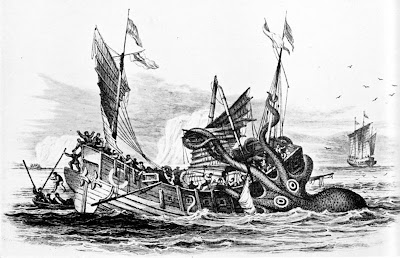 much larger second type, the colossal octopus (depicted in the above image), was reported to have attacked a sailing vessel from Saint-Malo, off the coast of Angola.
Montfort later dared more sensational claims. He proposed that ten British warships that had mysteriously disappeared one night in 1782 must have been attacked and sunk by giant octopuses. Unfortunately for Montfort, the British knew what had happened to the ships, resulting in a disgraceful revelation for Montfort. Pierre Dénys de Montfort's career never recovered and he died starving and poor in Paris around 1820 (Sjögren, 1980). In defence of Pierre Dénys de Montfort, it should be noted that many of his sources for the "kraken octopus" probably described the very real giant squid, proven to exist in 1857.
In 1830, possibly aware of Pierre Dénys de Montfort's work, Alfred Tennyson published his popular poem "The Kraken" (essentially an irregular sonnet), which disseminated Kraken in English forever fixed with its superfluous the. The poem in its last three lines, also bears similarities to the legend of Leviathan, a sea monster, who shall rise to the surface at the end of days.
Tennyson's description apparently influenced Jules Verne's imagined lair of the famous giant squid in Twenty Thousand Leagues Under the Sea from 1870. Verne also makes numerous references to Kraken, and Bishop Pontoppidan in the novel.
Later developments of the Kraken image may be traced at Kraken in popular culture.
Early accounts, including Pontoppidan's, describe the kraken as an animal "the size of a floating island" whose real danger for sailors was not the creature itself, but the whirlpool it created after quickly descending back into the ocean. However, Pontoppidan also described the destructive potential of the giant beast: "It is said that if it grabbed the largest warship, it could manage to pull it down to the bottom of the ocean" (Sjögren, 1980). Kraken were always distinct from sea serpents, also common in Scandinavian lore (Jörmungandr for instance). A representative early description is given by the Swede Jacob Wallenberg in his book Min son på galejan ("My son on the galley") from 178
 1:
1:"… Kraken, also called the Crab-fish, which [according to the pilots of Norway] is not that huge, for heads and tails counted, he is no larger than our Öland is wide [i.e. less than 16 km] ... He stays at the sea floor, constantly surrounded by innumerable small fishes, who serve as his food and are fed by him in return: for his meal, if I remember correctly what E. Pontoppidan writes, lasts no longer than three months, and another three are then needed to digest it. His excrements nurture in the following an army of lesser fish, and for this reason, fishermen plumb after his resting place ... Gradually, Kraken ascends to the surface, and when he is at ten to twelve fathoms, the boats had better move out of his vicinity, as he will shortly thereafter burst up, like a floating island, spurting water from his dreadful nostrils and making ring waves around him, which can reach many miles. Could one doubt that this is the Leviathan of Job? "
According to Pontoppidan, Norwegian fishermen often took the risk of trying to fish over kraken, since the catch was so good. If a fisherman had an unusually good catch, they used to say to each other, "You must have fished on Kraken." Pontoppidan also claimed that the monster was sometimes mistaken for an island, and that some maps that included islands that were only sometimes visible were actually indicating kraken. Pontoppidan also proposed that a young specimen of the monster once died and was washed ashore at Alstahaug (Bengt Sjögren, 1980).
Since the late 18th century, kraken have been depicted in a number of ways, primarily as large octopus-like creatures, and it has often been alleged that Pontoppidan's kraken might have been based on sailors' observations of the giant squid. In the earliest descriptions, however, the creatures were more crab- like than octopus-like, and generally possessed traits that are associated with large whales rather than with giant squid. Some traits of kraken resemble undersea volcanic activity occurring in the Iceland region, including bubbles of water; sudden, dangerous currents; and appearance of new islets.
In 1802, the French malacologist Pierre Dénys de Montfort recognized the existence of two kinds of giant octopus in Histoire Naturelle Générale et Particulière des Mollusques, an encyclopedic description of mollusks. Montfort claimed that the first type, the kraken octopus, had been described by Norwegian sailors and American whalers, as well as ancient writers such as Pliny the Elder. The
 much larger second type, the colossal octopus (depicted in the above image), was reported to have attacked a sailing vessel from Saint-Malo, off the coast of Angola.
Montfort later dared more sensational claims. He proposed that ten British warships that had mysteriously disappeared one night in 1782 must have been attacked and sunk by giant octopuses. Unfortunately for Montfort, the British knew what had happened to the ships, resulting in a disgraceful revelation for Montfort. Pierre Dénys de Montfort's career never recovered and he died starving and poor in Paris around 1820 (Sjögren, 1980). In defence of Pierre Dénys de Montfort, it should be noted that many of his sources for the "kraken octopus" probably described the very real giant squid, proven to exist in 1857.
In 1830, possibly aware of Pierre Dénys de Montfort's work, Alfred Tennyson published his popular poem "The Kraken" (essentially an irregular sonnet), which disseminated Kraken in English forever fixed with its superfluous the. The poem in its last three lines, also bears similarities to the legend of Leviathan, a sea monster, who shall rise to the surface at the end of days.
Tennyson's description apparently influenced Jules Verne's imagined lair of the famous giant squid in Twenty Thousand Leagues Under the Sea from 1870. Verne also makes numerous references to Kraken, and Bishop Pontoppidan in the novel.
Later developments of the Kraken image may be traced at Kraken in popular culture.
..read more...
The Legent of Sea Mosters "Charybdis"

In Greek mythology, Charybdis or Kharybdis (in Greek, Χάρυβδις) was a sea monster, daughter of Poseidon and Gaia. She takes form as a monstrous mouth. She swallows huge amounts of water three times a day and then belches them back out again creating whirlpools. Charybdis was originally a naiad, sea-nymph who flooded land to enlarge her father's underwater kingdom, until Zeus turned her into a monster. He was angry that she was taking so much of his land and made it so that she would be incredibly thirsty three times a day and suck in the water.
The myth has Charybdis lying on one side of a narrow channel of water. On the other side of the strait was Scylla, another sea-monster. The two sides of the strait are within an arrow's range of each other, so close that sailors attempting to avoid Charybdis will pass too close to Scylla and vice versa. The phrase between Scylla and Charybdis has come to mean being in a state where one is between two dangers and moving away from one will cause you to be in danger of the other. Between Scylla and Charybdis is the origin of the phrase "between the rock and the whirlpool" (the rock upon which Scylla dwelt and the whirlpool of Charybdis) and may be the genesis of the phrase "between a rock and a hard place".
The Argonauts were able to avoid both dangers because they were guided by Thetis, one of the Nereids. Odysseus was not so fortunate; he chose to risk Scylla at the cost of some of his crew rather than lose the whole ship to Charybdis. (Homer's Odyssey, Book XII). Odysseus successfully navigated the strait, losing only six men to Scylla. However, the men offended Helios by killing the god's sacred cattle, and Zeus retaliated by destroying ship and crew with a thunderbolt.
Stranded on a makeshift raft, Odysseus was swept back through the strait to face Scylla and Charybdis again. This time, Odysseus passed near Charybdis. His raft was sucked into Charybdis' maw, but Odysseus survived by clinging to a fig tree grown on the rock overhanging her lair. On the next outflow of water, his raft was expelled, and Odysseus was able to recover it and paddle away.
Traditionally, the location of Charybdis has been associated with the Strait of Messina off the coast of Sicily, opposite the rock called Scylla. The whirlpool there is caused by the meeting of currents, but is seldom dangerous. Recently scholars have looked again at the location and suggested this association was a misidentification and that a more likely origin for the story could be found close by Cape Skilla in north west Greece.
The myth has Charybdis lying on one side of a narrow channel of water. On the other side of the strait was Scylla, another sea-monster. The two sides of the strait are within an arrow's range of each other, so close that sailors attempting to avoid Charybdis will pass too close to Scylla and vice versa. The phrase between Scylla and Charybdis has come to mean being in a state where one is between two dangers and moving away from one will cause you to be in danger of the other. Between Scylla and Charybdis is the origin of the phrase "between the rock and the whirlpool" (the rock upon which Scylla dwelt and the whirlpool of Charybdis) and may be the genesis of the phrase "between a rock and a hard place".
The Argonauts were able to avoid both dangers because they were guided by Thetis, one of the Nereids. Odysseus was not so fortunate; he chose to risk Scylla at the cost of some of his crew rather than lose the whole ship to Charybdis. (Homer's Odyssey, Book XII). Odysseus successfully navigated the strait, losing only six men to Scylla. However, the men offended Helios by killing the god's sacred cattle, and Zeus retaliated by destroying ship and crew with a thunderbolt.
Stranded on a makeshift raft, Odysseus was swept back through the strait to face Scylla and Charybdis again. This time, Odysseus passed near Charybdis. His raft was sucked into Charybdis' maw, but Odysseus survived by clinging to a fig tree grown on the rock overhanging her lair. On the next outflow of water, his raft was expelled, and Odysseus was able to recover it and paddle away.
Traditionally, the location of Charybdis has been associated with the Strait of Messina off the coast of Sicily, opposite the rock called Scylla. The whirlpool there is caused by the meeting of currents, but is seldom dangerous. Recently scholars have looked again at the location and suggested this association was a misidentification and that a more likely origin for the story could be found close by Cape Skilla in north west Greece.
news source of www.wikipedia.org
..read more...
The Legent of Sea monster

Sea monsters or leviathans are sea-dwelling, mythical or legendary creatures, often believed to be of immense size.
Marine monsters can take many forms, including sea dragons, sea serpents, or multi-armed beasts; they can be slimy or scaly, often spouting jets of water. Often they are pictured threatening ships.
Marine monsters can take many forms, including sea dragons, sea serpents, or multi-armed beasts; they can be slimy or scaly, often spouting jets of water. Often they are pictured threatening ships.
Sightings and legendsHistorically
Decorative drawings of heraldic dolphins and sea monsters were frequently used to illustrate maps, such as the Carta marina. This practice died away with the advent of modern cartography. Nevertheless, stories of sea monsters and eyewitness accounts which claim to have seen these beasts persist to this day. Such sightings are often catalogued and studied by folklorists and cryptozoologists.
Sea monster accounts are found in virtually all cultures that have contact with the sea. Eyewitness accounts come from all over the world. For example, Avienus relates of Carthaginian explorer Himilco's voyage "...there monsters of the deep, and beasts swim amid the slow and sluggishly crawling ships." (lines 117-29 of Ora Maritima). Sir Humphrey Gilbert claimed to have encountered a lion-like monster with "glaring eyes" on his return voyage after formally claiming St. John's, Newfoundland (1583) for England. Another account of an encounter with a sea monster comes from July 1734. Hans Egede, a Danish/Norwegian missionary reported that on a voyage to Gothaab/Nuuk on the western coast of Greenland:
''[There] appeared a very terrible sea-animal, which raised itself so high above the water, that its head reached above our maintop. It had a long, sharp snout, and blew like a whale, had broad, large flippers, and the body was, as it were, covered with hard skin, and it was very wrinkled and uneven on its skin; moreover, on the lower part it was formed like a snake, and when it went under water again, it cast itself backwards, and in doing so, it raised its tail above the water, a whole ship length from its body. That evening, we had very bad weather.''
Sea monster accounts are found in virtually all cultures that have contact with the sea. Eyewitness accounts come from all over the world. For example, Avienus relates of Carthaginian explorer Himilco's voyage "...there monsters of the deep, and beasts swim amid the slow and sluggishly crawling ships." (lines 117-29 of Ora Maritima). Sir Humphrey Gilbert claimed to have encountered a lion-like monster with "glaring eyes" on his return voyage after formally claiming St. John's, Newfoundland (1583) for England. Another account of an encounter with a sea monster comes from July 1734. Hans Egede, a Danish/Norwegian missionary reported that on a voyage to Gothaab/Nuuk on the western coast of Greenland:
''[There] appeared a very terrible sea-animal, which raised itself so high above the water, that its head reached above our maintop. It had a long, sharp snout, and blew like a whale, had broad, large flippers, and the body was, as it were, covered with hard skin, and it was very wrinkled and uneven on its skin; moreover, on the lower part it was formed like a snake, and when it went under water again, it cast itself backwards, and in doing so, it raised its tail above the water, a whole ship length from its body. That evening, we had very bad weather.''
Other reports are known from the Pacific, Indian and Southern Oceans (e.g. see Heuvelmans 1968).
A more recent development has been the mysterious "Bloop" picked up by hydrophonic equipment since 1997. While matching the audio characteristics of an animal, it was deemed too large to be a whale. Investigations thus far have been inconclusive.
It is debatable what these modern "monsters" might be. Possibilities include frilled shark, basking shark, oarfish, giant squid, seiches, or whales. For example Ellis (1999) suggested the Egede-rellis-phooba monster might have been a giant squid. Other hypotheses are that modern-day monsters are surviving specimens of giant marine reptiles, such as ichthyosaur or plesiosaur, from the Jurassic and Cretaceous Periods, or extinct whales like Basilosaurus.
In 1892, Anthonid Cornelis Oudemans, then director of the Royal Zoological Gardens at The Hague saw the publication of his The Great Sea Serpent which suggested that many sea serpent reports were best accounted for as a previously unknown giant, long-necked pinniped.
It is likely that many other reports of sea monsters are misinterpreted sightings of shark and whale carcasses (see below), floating kelp, logs or other flotsam such as abandoned rafts, canoes and fishing nets.
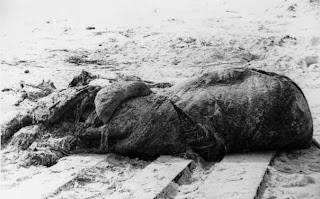 Alleged sea monster carcasses
A more recent development has been the mysterious "Bloop" picked up by hydrophonic equipment since 1997. While matching the audio characteristics of an animal, it was deemed too large to be a whale. Investigations thus far have been inconclusive.
It is debatable what these modern "monsters" might be. Possibilities include frilled shark, basking shark, oarfish, giant squid, seiches, or whales. For example Ellis (1999) suggested the Egede-rellis-phooba monster might have been a giant squid. Other hypotheses are that modern-day monsters are surviving specimens of giant marine reptiles, such as ichthyosaur or plesiosaur, from the Jurassic and Cretaceous Periods, or extinct whales like Basilosaurus.
In 1892, Anthonid Cornelis Oudemans, then director of the Royal Zoological Gardens at The Hague saw the publication of his The Great Sea Serpent which suggested that many sea serpent reports were best accounted for as a previously unknown giant, long-necked pinniped.
It is likely that many other reports of sea monsters are misinterpreted sightings of shark and whale carcasses (see below), floating kelp, logs or other flotsam such as abandoned rafts, canoes and fishing nets.
 Alleged sea monster carcasses
Sea monster corpses have been reported since recent antiquity (Heuvelmans 1968). Unidentified carcasses are often called globsters. The alleged plesiosaur netted by the Japanese trawler Zuiyo Maru off New Zealand caused a sensation in 1977 and was immortalized on a Brazilian postage stamp before it was suggested by the FBI to be the decomposing carcass of a basking shark. Likewise, DNA testing confirmed that an alleged sea monster washed up on Fortune Bay, Newfoundland in August, 2001, was a sperm whale.
Another modern example of a "sea monster" was the strange creature washed up on the Chilean sea shore in July, 2003. It was first described as a "mammoth jellyfish as long as a bus" but was later determined to be another corpse of a sperm whale. Cases of boneless, amorphic globsters are sometimes believed to be gigantic octopuses, but it has now been determined that sperm whales dying at sea decompose in such a way that the blubber detaches from the body, forming featureless whitish masses that sometimes exhibit a hairy texture due to exposed strands of collagen fibers. The analysis of the Zuiyo Maru carcass revealed a comparable phenomenon in decomposing basking shark carcasses, which lose most of the lower head area and the dorsal and caudal fins first, making them resemble a plesiosaur.
Another modern example of a "sea monster" was the strange creature washed up on the Chilean sea shore in July, 2003. It was first described as a "mammoth jellyfish as long as a bus" but was later determined to be another corpse of a sperm whale. Cases of boneless, amorphic globsters are sometimes believed to be gigantic octopuses, but it has now been determined that sperm whales dying at sea decompose in such a way that the blubber detaches from the body, forming featureless whitish masses that sometimes exhibit a hairy texture due to exposed strands of collagen fibers. The analysis of the Zuiyo Maru carcass revealed a comparable phenomenon in decomposing basking shark carcasses, which lose most of the lower head area and the dorsal and caudal fins first, making them resemble a plesiosaur.
news source of www.wikipedia.org
..read more...
Submarine canyon
A Submarine canyon is a steep-sided valley on the sea floor of the continental slope. Many submarine canyons are found as extensions to large rivers; however there are many that have no such association. Canyons cutting the continental slopes have been found at depths greater than 2 km below sea level. They are formed by powerful turbidity currents, volcanic and earthquake activity. Many submarine canyons continue as submarine channels across continental rise areas and may extend for hundreds of kilometers.
Characteristics
Submarine canyons are more common on steep slopes than on gentle slopes. They show erosion through all substrates, from unlithified sediment to crystalline rock. They are more densely spaced on steep slopes while being rare on gentle slopes. The walls are generally very steep and can be near vertical. The walls are subject to erosion by turbidity currents, bioerosion, or slumping
Examples of submarine canyons:
Examples of submarine canyons:
Congo canyon, the largest river canyon, extending from the Congo river, is 800 km (500 miles) long, and 1,200m (4000 ft) deep.
Amazon canyon, extending from the Amazon river.
Hudson canyon, extending from the Hudson river.
Ganges canyon, extending from the Ganges river.
Indus canyon, extending from the Indus river.
Monterey Canyon, off the coast of central California.
La Jolla and Scripps canyon, off the coast of La Jolla, southern California.
Whittard Canyon, Atlantic Ocean off southwest Ireland.
Bering Canyon, in the Bering sea Zhemchug Canyon the largest submarine canyon in the world, also in the Bering sea.
Formation of submarine canyons
Many mechanisms have been proposed for the formation of submarine canyons, and during the 1940s and 1950s the primary causes of submarine canyons were subject to active debate.
An early and obvious theory was that the canyons present today were carved during glacial times, when sea level was about 200 meters below present sea level, and rivers flowed to the edge of the continental shelf. However, while many (but not all) canyons are found offshore from major rivers, subaerial river erosion cannot have been active to the water depths as great as 3000 meters where canyons have been mapped, as it is well established (by many lines of evidence) that sea levels did not fall to those depths.
The major mechanism of canyon erosion is now thought to be turbidity currents and underwater landslides. Turbidity currents are dense, sediment-laden currents which flow downslope when an unstable mass of sediment that has been rapidly deposited on the upper slope fails, perhaps triggered by earthquakes. There is a spectrum of turbidity- or density-current types ranging from "muddy water" to massive mudflow, and evidence of both these end members can be observed in deposits associated with the deeper parts of submarine canyons and channels, such as lobate deposits (mudflow) and levees along channels.
Mass wasting, slumping, and submarine landslides are forms of slope failures (the effect of gravity on a hillslope) observed in submarine canyons. Mass wasting is the term used for the slower and smaller action of material moving downhill; and would commonly include the effects of bioerosion: the burrowing, ingestion and defecation of sediment performed by organisms. Slumping is generally used for rotational movement of masses on a hillside. Landslides, or slides, generally comprise the detachment and displacement of sediment masses. All are observed; all are contributory processes.
It is now understood that many mechanisms of submarine canyon creation have had effect to greater or lesser degree in different places, even within the same canyon, or at different times during a canyon's development. However, if a primary mechanism must be selected, the downslope lineal morphology of canyons and channels and the transportation of excavated or loose materials of the continental slope over extensive distances require that various kinds of turbidity or density currents act as major participants.
An early and obvious theory was that the canyons present today were carved during glacial times, when sea level was about 200 meters below present sea level, and rivers flowed to the edge of the continental shelf. However, while many (but not all) canyons are found offshore from major rivers, subaerial river erosion cannot have been active to the water depths as great as 3000 meters where canyons have been mapped, as it is well established (by many lines of evidence) that sea levels did not fall to those depths.
The major mechanism of canyon erosion is now thought to be turbidity currents and underwater landslides. Turbidity currents are dense, sediment-laden currents which flow downslope when an unstable mass of sediment that has been rapidly deposited on the upper slope fails, perhaps triggered by earthquakes. There is a spectrum of turbidity- or density-current types ranging from "muddy water" to massive mudflow, and evidence of both these end members can be observed in deposits associated with the deeper parts of submarine canyons and channels, such as lobate deposits (mudflow) and levees along channels.
Mass wasting, slumping, and submarine landslides are forms of slope failures (the effect of gravity on a hillslope) observed in submarine canyons. Mass wasting is the term used for the slower and smaller action of material moving downhill; and would commonly include the effects of bioerosion: the burrowing, ingestion and defecation of sediment performed by organisms. Slumping is generally used for rotational movement of masses on a hillside. Landslides, or slides, generally comprise the detachment and displacement of sediment masses. All are observed; all are contributory processes.
It is now understood that many mechanisms of submarine canyon creation have had effect to greater or lesser degree in different places, even within the same canyon, or at different times during a canyon's development. However, if a primary mechanism must be selected, the downslope lineal morphology of canyons and channels and the transportation of excavated or loose materials of the continental slope over extensive distances require that various kinds of turbidity or density currents act as major participants.
news source of www.wikipedia.org
..read more...
Deep sea fish
 Deep sea fish is a term for fish that live below the photic zone of the ocean. Examples include the lanternfish, flashlight fish, cookiecutter shark, bristlemouths, and anglerfish.
EnvironmentBecause the photic level zone lies only a few hundred meters below the water, about 90% of the ocean volume is invisible to humans. The deep sea is also an extremely hostile environment, with pressures between 20 and 1,000 atmospheres (between 2 and 100 megapascals), temperatures between 3 and 10 degrees Celsius, and a lack of oxygen. The fish that have evolved to this harsh environment are not capable of surviving in laboratory conditions, and any attempts to keep them in captivity have led to their deaths. For this reason little is known about them, as there are limitations to the amount of fruitful research that can be carried out on a dead specimen and deep sea exploratory equipment is very expensive. As such, many species are known only to scientists and have therefore retained their scientific names.
Characteristics
The fish of the deep sea are among the most elusive and unusual looking creatures on Earth. In this deep unknown lie many unusual creatures we still have yet to study. Since many of these fish live in regions where there is no natural illumination, they cannot rely solely on their eyesight for locating prey and mates and avoiding predators; deep sea fish have evolved appropriately to the extreme sub-photic region in which they live. Many deep sea fish are bioluminescent, with extremely large eyes adapted to the dark. Some have long feelers to help them locate prey or attract mates in the pitch dark of the deep ocean. The deep sea angler fish in particular has a long fishing-rod-like adaptation protruding from its face, on the end of which is a bioluminescent piece of skin that wriggles like a worm to lure its prey. The lifecycle of deep sea fish can be exclusively deep water although some species are born in shallower water and sink on becoming adults. 
Due to the poor level of photosynthetic light reaching deep sea environments, most fish need to rely on organic matter sinking from higher levels, or, in rare cases, hydrothermal vents for nutrients. This makes the deep sea much poorer in productivity than shallower regions. Consequently many species of deep sea fish are noticeably smaller and have larger mouths and guts than those living at shallower depths. It has also been found that the deeper a fish lives, the more jelly-like its flesh and the more minimal its bone structure. This makes them slower and less agile than surface fish.
Endangered Species
A recent study by Canadian scientists, has found five species of deep sea fish – roundnose grenadier, onion-eye grenadier, blue hake, spiny eel and spinytail skate – to be on the verge of extinction due to the shift of commercial fishing from continental shelves to the slopes of the continental shelves, down to depths of 1600 meters. The slow reproduction of these fish – they reach sexual maturity at about the same age as human beings – is one of the main reasons that they cannot recover from the excessive fishing.
news source of www.wikipedia.org
..read more...
Deep sea

The deep sea, or deep layer is the lowest layer in the ocean, existing below the thermocline. Little or no light penetrates this area of the ocean, and most of its organisms rely on falling organic matter produced in the photic zone for subsistence. For this reason life is much more sparse, becoming rarer still with increasing depth. The other essential ingredient for life is oxygen, which is brought to the ocean's depths via the thermohaline circulation. There is, however, another very different part of the deep sea food chain discovered in the late 1970s, which is rooted in chemosynthesis rather than photosynthesis.
The ocean depths are one of the most hostile environments for life, and represent the least explored of all the world's ecosystems. Cold, dark and almost inaccessible to humans, it is perhaps the closest environment on earth to outer space.
The ocean depths are one of the most hostile environments for life, and represent the least explored of all the world's ecosystems. Cold, dark and almost inaccessible to humans, it is perhaps the closest environment on earth to outer space.
Physical and chemical characteristics
The deep ocean is not well mixed, consists of horizontal layers of equal density, and is often as cold as -1 to 4°C (32 to 37°F). It is characterized by a nearly constant temperature and a positive sound speed gradient caused by pressure. Pressure increases by 1 atm with every 10 meters. Water at a depth of 4 km for example exerts 400 times more pressure than that at the surface.
Light dims by 90% every 75 meters; by 200m, the waters are dimly lit and by 1000m they receive no light at all. For comparison, the human visual threshold occurs at 650m. Ninety percent of the total volume of Earth's oceans is found in the deep ocean. The deepest waters on Earth lie 10,912m below the surface in the Mariana Trench.
Light dims by 90% every 75 meters; by 200m, the waters are dimly lit and by 1000m they receive no light at all. For comparison, the human visual threshold occurs at 650m. Ninety percent of the total volume of Earth's oceans is found in the deep ocean. The deepest waters on Earth lie 10,912m below the surface in the Mariana Trench.
Biology
Regions below the epipelagic are divided into further zones, beginning with the mesopelagic which spans from 200 to 1000m below sea level, where a little light penetrates while still being insufficient for primary production. Below this zone the deep sea proper begins, consisting of the aphotic bathypelagic, abyssopelagic and hadopelagic. Food consists of falling organic matter known as 'marine snow' and carcasses derived from the productive zone above, and is scarce both in terms of spatial and temporal distribution.
Adaptations of midwater fish
The midwater fish have special adaptations to cope with these conditions - they are small, usually being under 25cm; they have slow metabolisms and unspecialized diets, preferring to sit and wait for food rather than waste energy searching for it. They have elongated bodies with weak, watery muscles and skeletal structures. They often have extendable, hinged jaws with recurved teeth. Because of the sparse distribution and lack of light, finding a partner with which to breed is difficult, and many organisms are hermaphroditic.
Because light is so scarce fish often have larger than normal, tubular eyes with only rod cells. Their upward field of vision allows them to seek out the silhouette of possible prey. Prey fish however also have adaptations to cope with predation. These adaptations are mainly concerned with reduction of silhouette, a form of camouflage. The two main methods by which this is achieved are reduction in the area of their shadow by lateral compression of the body, and counter illumination via bioluminescence. This is achieved by production of light from ventral photophores, which tend to produce such light intensity to render the underside of the fish of similar appearance to the background light.
Because light is so scarce fish often have larger than normal, tubular eyes with only rod cells. Their upward field of vision allows them to seek out the silhouette of possible prey. Prey fish however also have adaptations to cope with predation. These adaptations are mainly concerned with reduction of silhouette, a form of camouflage. The two main methods by which this is achieved are reduction in the area of their shadow by lateral compression of the body, and counter illumination via bioluminescence. This is achieved by production of light from ventral photophores, which tend to produce such light intensity to render the underside of the fish of similar appearance to the background light.
Exploration
The deep sea is an environment totally inhospitable to humankind, and it should come as no surprise that it represents one of the least explored areas on Earth. Pressures even in the mesopelagic become too great for traditional exploration methods, demanding alternative approaches for deep sea research. Baited camera stations, small manned submersibles and ROVs (remotely operated vehicles) are three methods utilized to explore the ocean's depths. Because of the difficulty and cost of exploring this zone, current knowledge remains limited.
news source of www.wikipedia.org
..read more...
Langganan:
Postingan (Atom)
